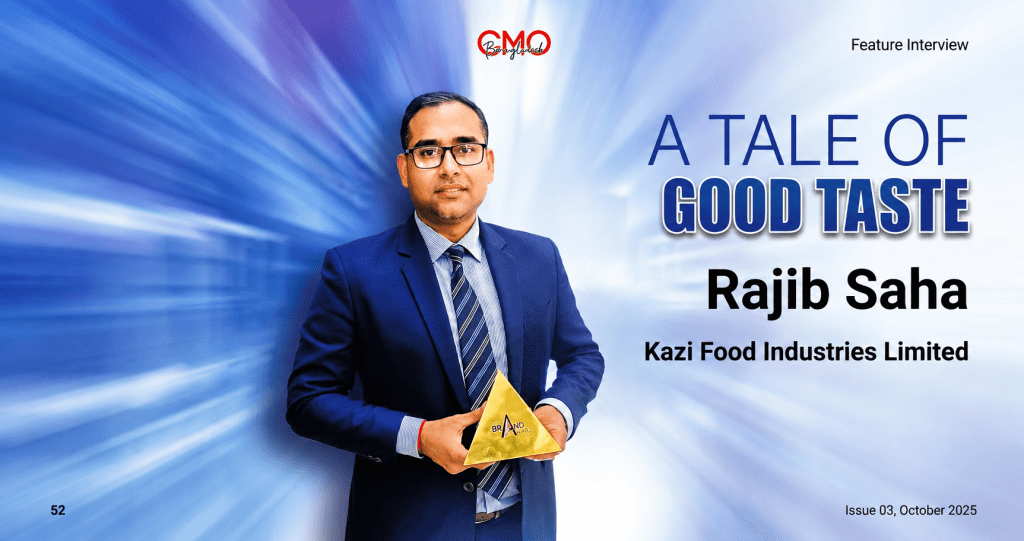
A Tale of Good Taste: Rajib Saha on Marketing Bangladesh’s Food and Beverage Industry
Rajib Saha has built a long career across Bangladesh’s food and beverage sector, working with brands spanning everyday staples to premium indulgence products. In this conversation, he reflects on his career path, the unique psychology of price sensitive consumers in Bangladesh, and what it really takes to succeed in F&B marketing.
From Creative Intern to F&B Marketing Veteran
Saha started his career as an intern at a creative firm, drawn in by the creative world, after completing a degree in Business Administration with a major in Marketing. He pushes back on the common idea that students gravitate toward marketing because they’re weak in math or finance, arguing the opposite is true since marketing ultimately comes down to sales targets, numbers, and metrics like MROI.
Early in his career, he moved between agency and corporate roles before settling into F&B, spending considerable time at Mediacom working across brands under the Square Group. He later built a long tenure at Kazi Food Industries Limited, with a stint at EON Foods in between, before returning to Kazi Food. Today, he describes the brands under Kazi Food’s Frozen Foods, Bakery, and Ice Cream divisions as feeling like home ground.
Breaking Consumer Misconceptions: The Packaged Chicken Challenge
While leading the marketing team at EON Food Limited, Saha worked on packaged dressed chicken at a time when consumers held strong misconceptions about the product, particularly around freshness, hygiene, nutritional value, and price.
The core challenge was a perception gap. Packaged chicken was priced higher than wet market chicken, and consumers assumed they were simply paying more. What they overlooked was that wet market chicken came with wastage such as feathers and intestines that inflated its apparent weight. Breaking down this perception barrier proved difficult, but once addressed, it not only benefited EON but opened up growth opportunities for other players in the category.
Launching Pista Kulfi: Pricing for Bangladesh’s Market
Another campaign Saha is proud of is the launch of Kazi Food’s Pista Kulfi ice cream, designed to make kulfi more accessible and affordable while still positioning it as a treat for everyone. The team relied heavily on consumer insights to settle on an optimum product weight of 280 grams and built the mould around that figure, then developed a pricing strategy aligned with local purchasing power.
Why Bangladeshi Consumers Are Price Sensitive in a Specific Way
Saha offers a detailed insight into local consumer psychology around pricing. Unlike markets such as India, where brands can nudge prices up by just one or two taka to offset inflation, that approach doesn’t work well in Bangladesh because consumers are uncomfortable handling one or two taka notes. In many cases, when a small price difference appears, consumers will buy the product anyway but leave the extra one or two taka unpaid, effectively treating it as informal credit that retailers know they’ll never recover. As a result, retailers tend to avoid stocking products that create this kind of friction, which is why price adjustments in Bangladesh typically happen in jumps of at least five taka, a pattern that can sharply affect both demand and revenue.
He also notes that mass-market consumers in Bangladesh tend to care less about the exact weight of a product and more about whether it’s available in a size or pack that fits their budget, which is why smaller pack sizes often prove more effective at sustaining consistent demand.
Why Ice Cream Cafés Struggle in Bangladesh
Saha shares his perspective on why so many local and global ice cream café concepts have underperformed in Bangladesh. He points to the high fixed costs tied to the spacious, café-like environments these brands typically require, despite the fact that ice cream is fundamentally an impulse purchase rather than a staple food.
A café format built around long customer dwell time works for businesses with broader menus, but becomes unsustainable when the core offering is only ice cream, since adding non-dessert items to compensate often shifts focus away from the core product itself. In his view, a takeaway-focused model performs far better for ice cream brands in this market, and he notes that the retail ice cream brands seeing better performance tend to follow that approach.
A Genuine Foodie With a No-Waste Philosophy
Saha describes himself as a committed foodie, someone his friends and family enjoy feeding because of his genuine love of food. Through his travels to some of Bangladesh’s more remote areas, he makes a point of trying local specialties wherever he finds them, showing no preference between street food and fine dining. At the same time, he holds firmly to a personal value of never wasting food, taking only what he can finish and encouraging others to do the same.
GI Recognition for Heritage Foods: Opportunity or Missed Potential?
Saha views the growing GI (Geographical Indication) recognition for Bangladeshi heritage foods as a genuinely positive development, but voices some uncertainty about whether the country will be able to fully capitalize on it. He suggests that government involvement could help develop national brands around items like Bogura’s curd, Natore’s kachagolla, Cumilla’s rasmalai, Tangail’s porabari chamcham, Kushtia’s tiler khaja, and Chhanamukhi from Brahmanbaria, including showcasing them at international trade fairs.
He cautions that privatization alone could risk compromising authenticity and quality, and given Bangladesh’s track record with underutilizing its tourism potential, he remains uncertain whether GI-recognized foods can realistically become a strong tool for national branding.
Best Practices Saha Recommends to New Marketers
Saha closes with several pieces of advice for marketers entering the field. He first pushes back on the idea of marketing as an escape route from mathematics, arguing it’s actually a highly quantitative discipline where data-driven decision making is increasingly central to success, making numerical fluency an asset rather than a weakness.
Second, he encourages adopting a “get the job done” mindset, since he sees the role of a business manager as finding solutions rather than surfacing complaints.
Third, despite how it might sound, he insists that marketers need genuine love for the work, since the job isn’t always glamorous or immediately rewarding, and performance suffers without real passion behind it.
Finally, and perhaps most importantly, he emphasizes truly knowing your customers, arguing this can’t be achieved from behind a desk. He encourages marketers to get out, talk to people, and travel across the country, since the insights gained that way can shape a marketing perspective in ways no report ever could.