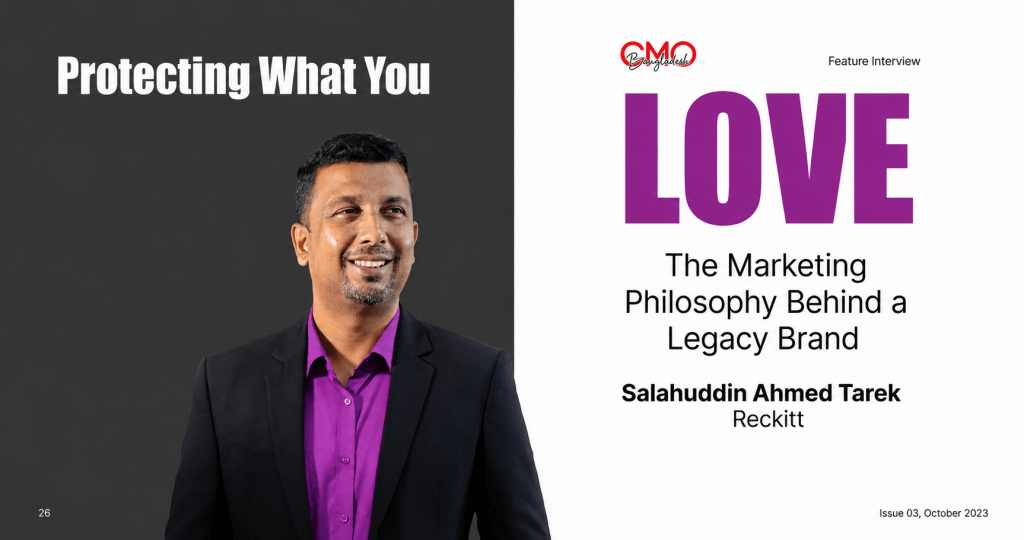
Protecting What You Love: The Marketing Philosophy Behind a Legacy Brand
With over a decade at one of the world’s leading consumer goods companies, Salahuddin Ahmed Tarek has built a career steering some of Bangladesh’s most recognizable household brands. As Senior Marketing Manager for Health and Head of Partnership at Reckitt Bangladesh, he shares his journey through the company, the thinking behind Dettol’s award winning campaign, and his views on the challenges facing modern marketers.
A Journey Across Reckitt’s Brand Portfolio
Tarek has spent nearly 12 years at Reckitt, and his career path has taken him through almost every corner of the business. He started out managing the pest control category with the Mortein brand, then took on the entire Home Care portfolio, including Harpic. From there he moved into Sales for hands on field experience, followed by a stint leading Trade Marketing, before returning to his core interest of Brand Marketing and eventually taking on his current role across the Health portfolio.
While he describes every brand as a rewarding experience in its own way, Dettol stands out for him personally. He points to the brand’s 75 year legacy in Bangladesh, a history that predates the country’s independence, and its deep association with protection, family, and the bond between a mother and her child. For Tarek, Dettol functions less like a typical product and more like a trusted presence in households across the country.
Building on Dettol’s Legacy: The “Protect What You Love” Campaign
Tarek explains that the “Protect What You Love” platform was designed to move the brand’s messaging beyond standard germ kill statistics. The idea centers on health as the foundation that allows people to pursue what matters most to them, whether that’s family, career, or personal passion, since illness can disrupt all of it.
To mark the brand’s 75th anniversary in 2025, the campaign shifted focus toward honoring real, unsung individuals in Bangladesh who have made significant personal sacrifices for the people or causes they love. Among the stories featured was Ziaul Haque of Chapainawabganj, who has self funded a free library for children since 1969 after being unable to afford books himself as a child. Another was Rikta Akter Banu of Chilmari, who sold her own land to build a school after her daughter, who has cerebral palsy, had nowhere to study; that school now serves 300 children with special needs. According to Tarek, these stories reflect the same values of protection and care that the brand has represented for 75 years, positioning the campaign as an exercise in legacy building rather than simple product promotion.
Tackling the Counterfeit Products Challenge in Bangladesh
Counterfeiting remains a persistent and complicated issue for Reckitt, particularly with brands like Harpic and Veet. Tarek attributes this to gaps in law enforcement combined with the sheer scale of the problem, which he says is too large for any single company to address alone.
While bodies like the Bangladesh Standards and Testing Institution (BSTI) carry out raids and surveys, Tarek notes their impact is often short lived, since a fined business can resume operating within a week. He frames the risk as twofold: consumers are exposed to substandard and potentially unsafe products, while legitimate businesses that invest properly and pay taxes are placed at a disadvantage. He believes a more coordinated approach between government and private sector is necessary for a lasting solution.
The State of Influencer Marketing in Bangladesh
Tarek sees influencer marketing as a genuinely effective channel, particularly for reaching younger audiences like Gen Z who tend to trust creators they follow. Reckitt uses influencers selectively, citing Dettol Body Wash as an example of a brand where the approach fits a younger, lifestyle driven audience.
That said, he views the local industry as still maturing, pointing to the lack of professional structure as the biggest gap. Unlike celebrity endorsements that run through managers, most influencers in Bangladesh operate independently, which leads to inconsistent rates, a focus on quantity over quality, and sometimes a weaker grasp of a brand’s core message. Tarek believes professional influencer marketing agencies could bridge this gap by standardizing processes and helping both brands and creators get more value from partnerships.
Career Reflections: Basketball, Entrepreneurship, and What’s Next
Tarek reveals that his passion for basketball was strong enough during university that he seriously considered a sports career, even playing in the second division league.
Looking forward, his long term ambition is entrepreneurship. Having learned from mentors throughout his career, he hopes to eventually build something of his own, ideally combining his marketing background with his lifelong interest in sports, a venture he describes as a natural fit.
His Philosophy on Managing Stress
Tarek’s approach to stress is built around early action. He compares an unresolved problem to a small kitchen fire: handled immediately, it stays contained, but left alone, it spreads and eventually becomes a crisis everyone notices. He applies the same logic to work, addressing issues before they have the chance to escalate.
Practically, he keeps a simple notebook where he lists and prioritizes his tasks, crossing each one off as it’s completed. He credits this habit of keeping work visible and tackling it proactively as the most effective tool he’s used throughout his career for staying in control.